
Opening a monthly utility statement from the City of Whittier Water Utility or Suburban Water Systems only to discover that your bill has surged by $150, $300, or even $700 is an alarming experience. You immediately check the kitchen faucet, inspect under the bathroom vanity, and walk outside to look for telltale puddles—yet everything appears completely dry. Where is all that water going?
When water usage spikes without a visible flood, the leak is almost certainly concealed within the architectural structure or buried beneath your property. In Southern California, single-family homes in neighborhoods like East Whittier, Whittwood, and Uptown Whittier frequently experience sub-slab copper pinholes or yard service line fractures that discharge hundreds of gallons per day directly into porous soil or sub-base gravel without creating a single surface puddle.
Before you panic or start breaking into drywall, follow this proven 5-step diagnostic protocol. This process will help you isolate whether the water loss is occurring inside your home, beneath your foundation, or out in the yard, empowering you to take decisive action.
In This Diagnostic Guide:
- Step 1: The 15-Minute Water Meter "No-Use" Indicator Test
- Step 2: Main Shutoff Valve Isolation (Indoor vs. Outdoor)
- Step 3: Fixture Isolation & The Toilet Flapper Dye Test
- Step 4: Inspecting for Subtle Physical Micro-Symptoms
- Step 5: When Professional Non-Invasive Detection Is Required
- Bonus: How to Request a City of Whittier Leak Bill Adjustment
- Frequently Asked Questions
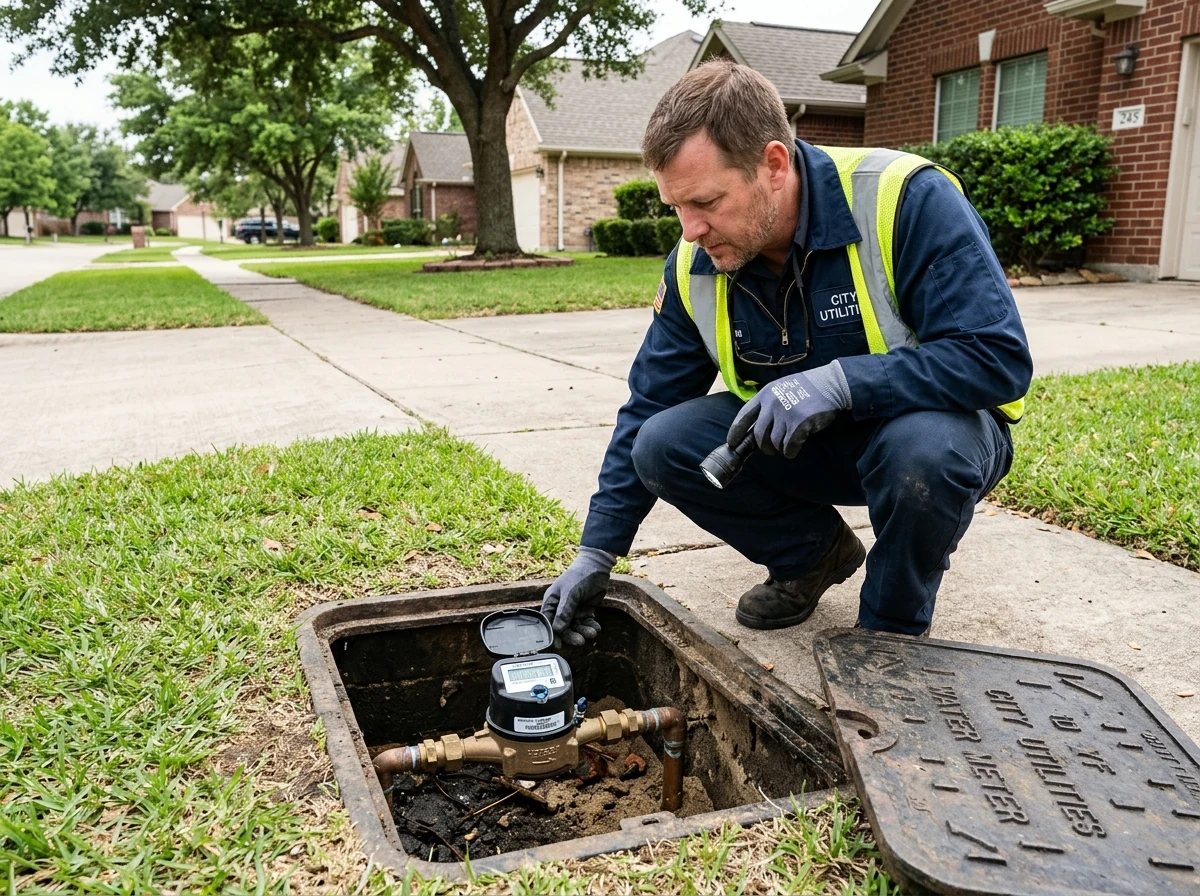
Step 1: The 15-Minute Water Meter "No-Use" Indicator Test
Your municipal water meter is the single most accurate diagnostic instrument available on your property. It records every cubic foot or gallon that passes through the municipal supply into your private plumbing.
How to Perform the "No-Use" Test:
- Shut Off All Indoor & Outdoor Fixtures: Ensure that no faucets are running, no washing machines or dishwashers are cycling, and all landscape irrigation timers are deactivated. Do not flush any toilets during the test.
- Locate Your Water Meter: In Whittier, your water meter is typically situated near the street or sidewalk inside an in-ground concrete box with a cast-iron or composite lid labeled "WATER". Carefully lift the lid using a slotted screwdriver or curb key.
- Inspect the Low-Flow Indicator:
- Analog Dials: Look for a small red or silver triangle, star-shaped wheel, or small gear near the center of the register. This is the low-flow indicator. If it is slowly rotating while all water in the house is turned off, pressurized water is actively leaving the pipe network.
- Digital Smart Meters: Digital LCD displays feature a small faucet icon or flashing droplet symbol indicating active flow. Note the exact numerical reading down to the tenth of a gallon.
- Wait 15 to 20 Minutes: If the low-flow dial isn't visibly spinning rapidly, record the exact meter register numbers. Leave all fixtures off and return in 20 minutes. If the reading has changed at all, you have confirmed a pressurized hidden leak.
💡 Pro Tip on Meter Ownership
In California, the municipal water purveyor owns the water meter itself. However, from the downstream meter coupling to your home inlet, all underground supply piping, valves, and interior plumbing lines are the homeowner's legal responsibility.
Step 2: Main Shutoff Valve Isolation (Indoor vs. Outdoor)
Once the meter test confirms that water is escaping, your next objective is to cut the property in half: Is the leak located before or after your home's main shutoff valve?
Locate your home's primary customer shutoff valve. On most single-family residences in Whittier (whether in Friendly Hills, South Whittier, or Michigan Park), this valve is located on the exterior front wall near the hose bib riser, or in an access box where the supply line enters the foundation.
Isolating the Branch:
- Turn your home's main shutoff valve completely clockwise until it is fully closed. (This halts all water delivery to your interior bathrooms, kitchen, water heater, and indoor fixtures).
- Walk back out to your street water meter and observe the low-flow indicator:
- Case A: The Meter Stops Completely. This proves that the leak is located inside the home or beneath the concrete foundation slab. The underground yard line between the meter and the house is intact.
- Case B: The Meter Continues to Spin. Because all water to the house has been stopped, water is escaping between the street meter and your foundation wall. This indicates an underground water service line rupture, cracked irrigation manifold, or damaged main supply pipe.
Step 3: Fixture Isolation & The Toilet Flapper Dye Test
If the meter stopped when you shut off the house valve, your leak is on the interior plumbing system. Before assuming you have a serious foundation slab failure, rule out silent fixture culprits.
The most common cause of high water bills that produces zero water damage is a silent toilet flapper leak. A degraded flapper valve allows water to continuously siphon down the overflow tube into the sewer line. A moderately leaking flapper can silently waste between 200 and 1,000 gallons of water per day—easily adding $100 to $300 to your monthly utility charge!
How to Perform the Dye Test:
- Remove the lid from each toilet tank in your home.
- Drop 5 to 6 drops of dark food coloring (blue or red) or a dye tablet into the tank water. Do not flush.
- Wait 15 minutes without using the toilet.
- Inspect the toilet bowl. If colored water has seeped into the bowl without flushing, the flapper or flush valve seal has failed and is siphoning water 24/7.
Also inspect your water heater's temperature and pressure relief (T&P) discharge pipe, water softener regeneration valves, and reverse osmosis drainage lines. If all fixture tests pass and your meter still indicates continuous flow, you are dealing with a concealed pressurized line leak.
Step 4: Inspecting for Subtle Physical Micro-Symptoms
Concealed plumbing leaks inside walls or beneath concrete foundation slabs leave subtle physical signatures. Take 10 minutes to walk your property and check for these warning signs:
- Localized Floor Warmth: Walk barefoot across tile, vinyl plank, or hardwood flooring. In Southern California, domestic hot water copper lines embedded beneath concrete slabs frequently rupture first due to thermal expansion. If you feel a warm patch on the floor, you likely have an active hot water slab leak.
- Audible Hissing or Water Rushing: Turn off all televisions and appliances late at night. Walk quietly through hallways and near bathrooms. A continuous faint hissing, rushing, or whistling sound behind baseboards indicates pressurized water escaping through a pinhole.
- Warping Baseboards or Moisture Rings: Examine the bottom 3 inches of drywall and baseboard molding along interior partition walls. Water wicking up from the concrete slab will cause paint bubbling, dark staining, or wood swelling.
- Spongy Turf or Overgrown Grass: Out in the yard, look for patches of grass that appear noticeably greener, spongier, or taller than surrounding turf, especially along the alignment between the street meter and your home entrance.
Step 5: When Professional Non-Invasive Detection Is Required
If you have confirmed continuous flow at the meter and ruled out running toilets, do not allow a contractor to begin guessing by cutting random holes into drywall or jackhammering your floor.
Modern leak detection is an advanced, non-destructive diagnostic discipline. Professional leak detection technicians deployed through Whittier Leak Detection Pros utilize specialized scientific instrumentation to isolate the leak coordinate within inches:
- Electro-Acoustic Ground Listening Probes: Sensitive ground microphones capture the acoustic frequency of water escaping under 50–80 PSI of pressure. High-frequency digital filters isolate the pipe sound directly through concrete foundation slabs, finished hardwood, and tile. Learn more about our acoustic leak detection technology.
- High-Resolution Infrared Thermography: Calibrated FLIR thermal imaging cameras scan flooring and interior walls to visualize thermal plumes created by concealed hot water lines or evaporative moisture tracks. Explore thermal imaging leak detection.
- Hydrostatic Pressure Decay & Line Tracing: Specialized gauges isolate hot and cold supply branches individually to determine precisely which pipe manifold is compromised before any repair is planned.
Common Sources of Hidden Water Spikes Compared
| Leak Source | Water Wasted / Day | Visible Surface Signs | Diagnostic Method | Urgency Level |
|---|---|---|---|---|
| Slab Foundation Leak | 250 – 1,500+ gal | Warm floor, damp baseboard | Acoustic probe & thermal camera | High (Structural risk) |
| Underground Yard Line | 500 – 3,000+ gal | Spongy turf or zero sign | Meter isolation & ground mic | Moderate to High |
| Hidden Drywall Pipe | 100 – 600 gal | Peeling paint, musty odor | Pinless moisture meter | High (Mold risk) |
| Silent Toilet Flapper | 200 – 1,000 gal | Zero surface signs (drains to sewer) | Food coloring dye test | Moderate (Financial loss) |
| Irrigation Zone Valve | 150 – 800 gal | Standing water in valve box | Zone shutoff & pressure test | Moderate |
How to Request a Water Bill Adjustment in Whittier, CA
Many Whittier residents are unaware that local water purveyors—including the City of Whittier Water Division and Suburban Water Systems—offer formal leak adjustment relief policies for property owners who experience verifiable underground or hidden leaks.
How to Qualify for a Bill Adjustment:
- Secure Professional Diagnostic Documentation: The utility typically requires proof that an abnormal, non-visible leak occurred and was promptly isolated by a professional leak detection service or licensed plumbing contractor.
- Retain Repair Invoices: Maintain copies of the repair invoice clearly describing the location of the break (e.g., "repaired underground 1-inch copper main service line" or "rerouted hot water foundation slab loop").
- Verify Meter Normalization: Ensure that your water meter reading has returned to normal baseline usage for at least 14 days following the repair.
- Submit the Adjustment Request: Contact City of Whittier utility billing within 60 to 90 days of the spiked billing cycle. If approved, the utility will often adjust the excessive billing units back to your historical average or credit the tiered penalty charges.
Next Steps: Don't Let Water Bills Drain Your Budget
A high water bill with no visible puddle is an urgent warning sign, not a mystery to ignore. Every day a pressurized copper line leaks beneath your concrete slab or lawn, hundreds of gallons of treated municipal water wash away soil, soften foundations, and inflate utility penalties.
If your "no-use" water meter test confirms active water loss, speak directly with our team at (562) 245-5818. We coordinate priority dispatch with experienced, independent non-invasive diagnostic specialists across all 10 Whittier ZIP codes (90601–90610).
Frequently Asked Questions
How much water can a hidden pinhole pipe leak waste per month?
A pressurized pinhole leak as small as 1/16 of an inch running at standard 60 PSI domestic pressure can discharge between 20,000 and 25,000 gallons of water in a single 30-day billing cycle. At tiered municipal rates, this easily adds $200 to $500 or more to your monthly bill.
Why don't slab leaks always show puddles inside the house?
In Southern California, homes built on concrete slab foundations sit atop layers of sand and crushed gravel. Escaping water follows the path of least resistance, draining directly down into the porous sub-base soil rather than forcing its way upward through 4 to 6 inches of reinforced concrete and flooring.
Can a sprinkler system leak cause my water meter to spin when it is turned off?
Yes. If the underground sprinkler zone control valve fails to seat completely or if the mainline pipe leading from the backflow preventer to the valve manifold develops a crack, water will flow continuously even when the irrigation controller timer is turned off.
Does homeowners insurance pay for water leak detection in California?
Most standard California homeowner insurance policies cover the "tear-out" and access costs required to locate and reach a hidden leak under a slab, as well as resultant structural water damage. However, the plumbing pipe repair itself is typically considered regular homeowner maintenance. Always request formal diagnostic documentation to submit with your insurance claim.
How quickly can a technician locate a hidden water leak in Whittier?
Using electro-acoustic listening probes and infrared thermal imaging, an experienced diagnostic technician can typically isolate the precise coordinates of a hidden slab or yard pipe leak within 60 to 90 minutes of arriving on site.