
For generations, diagnosing a hidden water leak was a destructive nightmare. A plumber would walk into a Whittier home, spot a damp patch of drywall or warm floor tile, and start swinging a sledgehammer—hoping that after knocking several holes in your foundation or plaster, they might stumble upon the leaking pipe. Today, modern electronic leak detection has replaced exploratory demolition with pin-point forensic science.
At Whittier Leak Detection Pros, non-invasive diagnostics allow our technicians to map pressurized pipe ruptures beneath solid concrete slabs, behind vintage lathe-and-plaster walls, and 6 feet underground in landscaped yards—all with zero destructive demolition. Here is an inside look at the advanced acoustic, infrared, and tracer gas physics that make precision detection possible.
The End of Exploratory Sledgehammering
Because water naturally travels along structural framing, sub-slab gravel, and gravity conduits before emerging on a surface, the point where water appears is rarely where the pipe actually broke. Breaking concrete at the visible damp spot often results in demolished flooring 15 feet away from the actual leak source.
Non-invasive leak detection isolates the exact physical coordinates of the rupture prior to any repair work, saving Whittier property owners thousands of dollars in unnecessary flooring replacement and structural restoration.
The Physics: How Escaping Water Creates Acoustic Signatures
Residential municipal water in Whittier arrives at your property under high pressure—typically between 55 and 80 pounds per square inch (PSI). When a copper, galvanized, or PEX pipe develops a hairline fissure or pinhole crack, water is forced through the microscopic opening at extreme velocity.
This high-velocity escape creates distinct, predictable physical phenomena:
- Pipe Vibration: The escaping fluid creates longitudinal mechanical vibrations that travel along the metal or plastic pipe wall for dozens of feet.
- Orifice Friction Noise: As water shears against the jagged metal edges of the rupture, it generates a high-frequency acoustic hiss (typically between 800 Hz and 2,500 Hz).
- Impact Noise: The jet of water colliding with the surrounding compacted soil, gravel bed, or concrete slab generates low-frequency rumble and cavitation sounds (100 Hz to 500 Hz).
Technology 1: Electro-Acoustic Ground Listening & Filtration
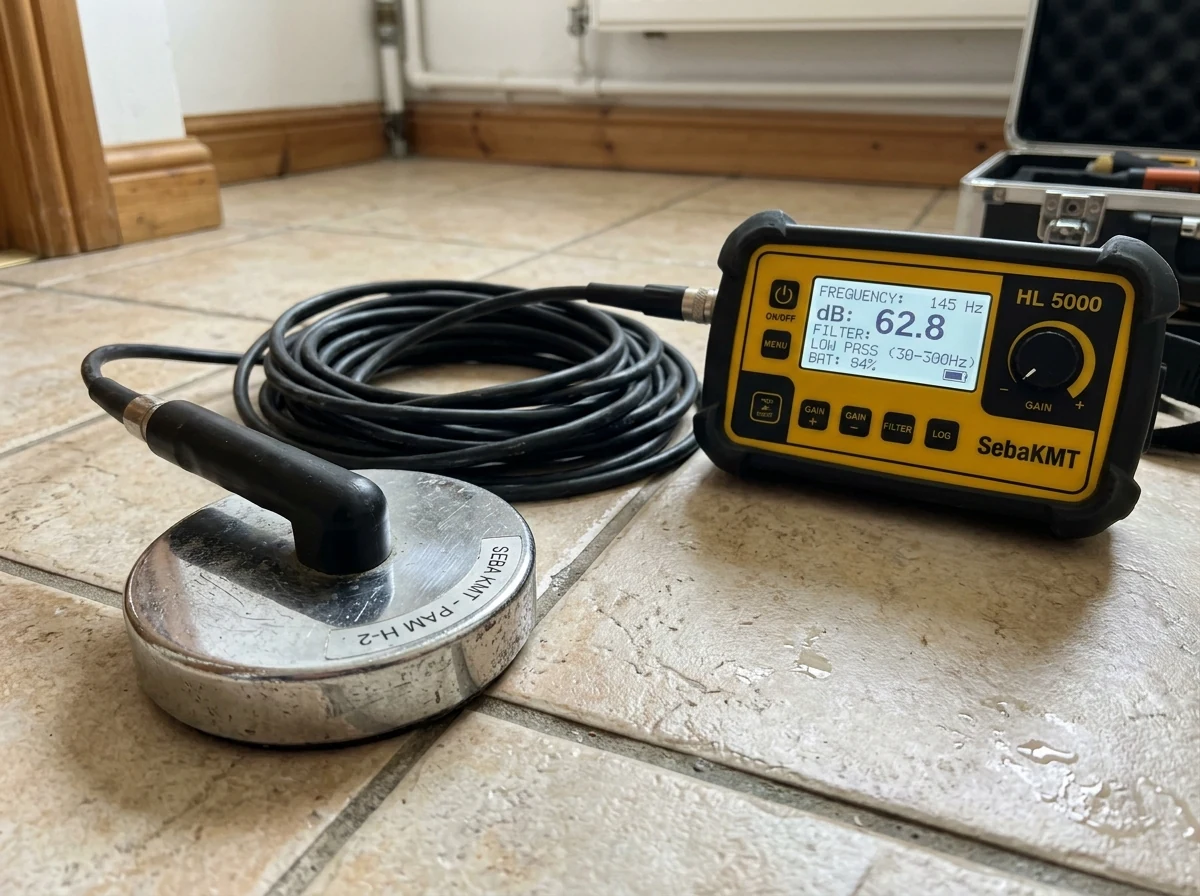
The primary weapon in an electronic detection specialist's arsenal is the electro-acoustic listening system (such as Sewerin, SubSurface, or Gutermann industrial acoustic locators). These instruments feature ultra-sensitive piezoelectric ceramic sensors capable of amplifying ground vibrations by over 100,000 times.
Digital Frequency Filtration
The biggest challenge in suburban Whittier is ambient noise—traffic along Whittier Blvd or Colima Rd, barking dogs, and running air conditioning units. Advanced acoustic units feature digital signal processors (DSP) that notch out ambient low-end rumble and high-end chatter, allowing the technician to isolate the exact narrow frequency band created by escaping pressurized water.
By moving an acoustic ground sensor in a tight grid across the floor, the technician monitors digital decibel readings. The exact point where signal amplitude peaks and frequency narrows indicates the precise location of the sub-slab rupture.
Technology 2: High-Resolution FLIR Thermal Thermography
While acoustic equipment listens to leaks, high-resolution FLIR infrared thermal cameras allow technicians to see them. Thermal thermography measures infrared radiation (surface temperature differentials) that is completely invisible to the human eye.
Thermal cameras are particularly devastating against hot water foundation slab leaks:
- As 120°F water escapes a hot supply line under a foundation, heat conducts upward through 4 inches of concrete, creating a distinctive thermal plume on the floor surface.
- The thermal camera displays a real-time, color-coded temperature gradient: deep blue and purple for cold foundation areas, transitioning into vivid orange and bright white at the center of the subterranean heat plume.
- The hottest point of the plume pinpoint marks the subterranean failure point to within a 6-inch circle.
Technology 3: Inert Hydrogen/Nitrogen Tracer Gas Sniffers
What happens when a pipe rupture is so microscopic that it produces minimal acoustic vibration, or when ambient soil is so saturated that sound waves are muffled? This is where molecular tracer gas detection excels.
The process is safe, non-toxic, and non-destructive:
- The domestic water line is isolated and gently drained of standing water.
- A medical-grade, non-flammable gas mixture (95% nitrogen and 5% hydrogen) is introduced under safe operating pressure.
- Because hydrogen molecules are the smallest and lightest in the universe, they easily escape the microscopic fissure and migrate straight up through concrete slabs, tile grout, asphalt, and compacted soil.
- The technician sweeps a sensitive electronic hydrogen sniffer along the floor. The detector registers hydrogen concentrations in parts per million (PPM), instantly flagging the exact rupture point.
Pinpoint Precision Without Damage
Our non-invasive diagnostic protocols protect historic hardwood floors in Uptown Whittier and luxury tiled entries in Friendly Hills from unnecessary damage. Call (562) 245-5818 to schedule precision electronic diagnostics.
Technology 4: Non-Penetrating Subsurface Moisture Meters
To detect leaks hidden behind drywall, ceilings, and cabinetry without drilling holes, technicians employ radio-frequency impedance moisture meters. These instruments transmit electromagnetic signals into building materials up to 1 inch deep, measuring capacitive impedance to determine moisture content without marring finished paint or wallpaper.
Step-by-Step: What to Expect During an On-Site Inspection
System Pressure & Isolation Testing
The technician attaches precision digital pressure gauges to your plumbing system, shutting off the municipal meter to confirm pressure decay rates and verify the leak is on the pressurized supply line.
Thermal Imaging Scan
An infrared walkthrough of all ground-floor rooms identifies thermal anomalies under floors or behind baseboards.
Acoustic Ground Mapping
Using ground microphones, the specialist walks the suspected line path, filtering frequencies to zero in on the highest decibel point of escaping water.
Physical Markings & Written Report
The exact failure spot is marked with non-permanent tape, and a comprehensive diagnostic report is provided for repair plumbers and insurance adjusters.
Comparison: Invasive Guesswork vs. Electronic Precision
| Diagnostic Factor | Outdated Invasive Guesswork | Modern Non-Invasive Electronics |
|---|---|---|
| Property Impact | Multiple exploratory holes in concrete, tile, and drywall | Zero structural damage; 100% surface-level scanning |
| Accuracy | Vague guess within 10 to 15 feet | Pinpointed within inches of the actual rupture |
| Restoration Cost | Thousands in concrete repouring and new flooring | Minimal; single focused access point or overhead reroute |
| Insurance Acceptance | Adjusters often contest exploratory demolition bills | Detailed forensic reports fast-track claim approvals |
Frequently Asked Questions
Can acoustic sensors hear through ceramic tile, hardwood, and carpet?
Yes. Specialized acoustic ground microphones feature solid brass contact plates and sensitive transducers designed to capture acoustic resonance through dense materials like ceramic tile, stone, engineered wood, and carpet padding without causing any scratch or surface blemish.
How long does a complete non-invasive inspection take?
A typical residential leak detection inspection takes between 1.5 and 3 hours depending on property size, plumbing complexity, and background noise levels. Our technicians do not leave until the leak is definitively isolated and marked.
Can you detect leaks in plastic PEX piping?
Yes. While plastic PEX pipe does not transmit acoustic vibration as far along its length as copper, water escaping under pressure still generates significant soil friction noise and thermal gradients. Combining acoustic filtration, thermal imaging, and tracer gas allows reliable pinpointing in all pipe materials.