
Discovering an underground plumbing leak beneath your concrete foundation is distressing enough—but when homeowners begin imagining jackhammers tearing through Italian porcelain tile, the financial anxiety can be overwhelming. The most common question Whittier homeowners ask us is: Will my homeowners insurance pay for this?
The short answer in California is: Yes, partially—and often for the most expensive parts of the job. However, coverage depends entirely on how standard insurance policies distinguish between finding the leak, accessing the pipe, replacing the plumbing fitting, and restoring secondary water damage. Below is the definitive California homeowner's guide to navigating slab leak insurance claims with carriers like State Farm, Farmers, Mercury, AAA, and Travelers.
The Reality of California Homeowners Insurance & Slab Leaks
Most single-family homes across Whittier and Los Angeles County are insured under an ISO HO-3 Special Form policy or a proprietary equivalent. These policies operate on an "open perils" basis for the primary dwelling structure, meaning that damage is covered unless explicitly excluded.
While policies exclude standard wear-and-tear, corrosion, and routine plumbing maintenance, they routinely cover the consequential tear-out and water damage resulting from sudden pipe ruptures.
The 3 Distinct Components of Every Slab Leak Claim
Insurance adjusters dissect a foundation slab leak into three separate financial buckets. Understanding these categories is essential for setting expectations and communicating with your adjuster:
Leak Detection & Diagnostic Inspection
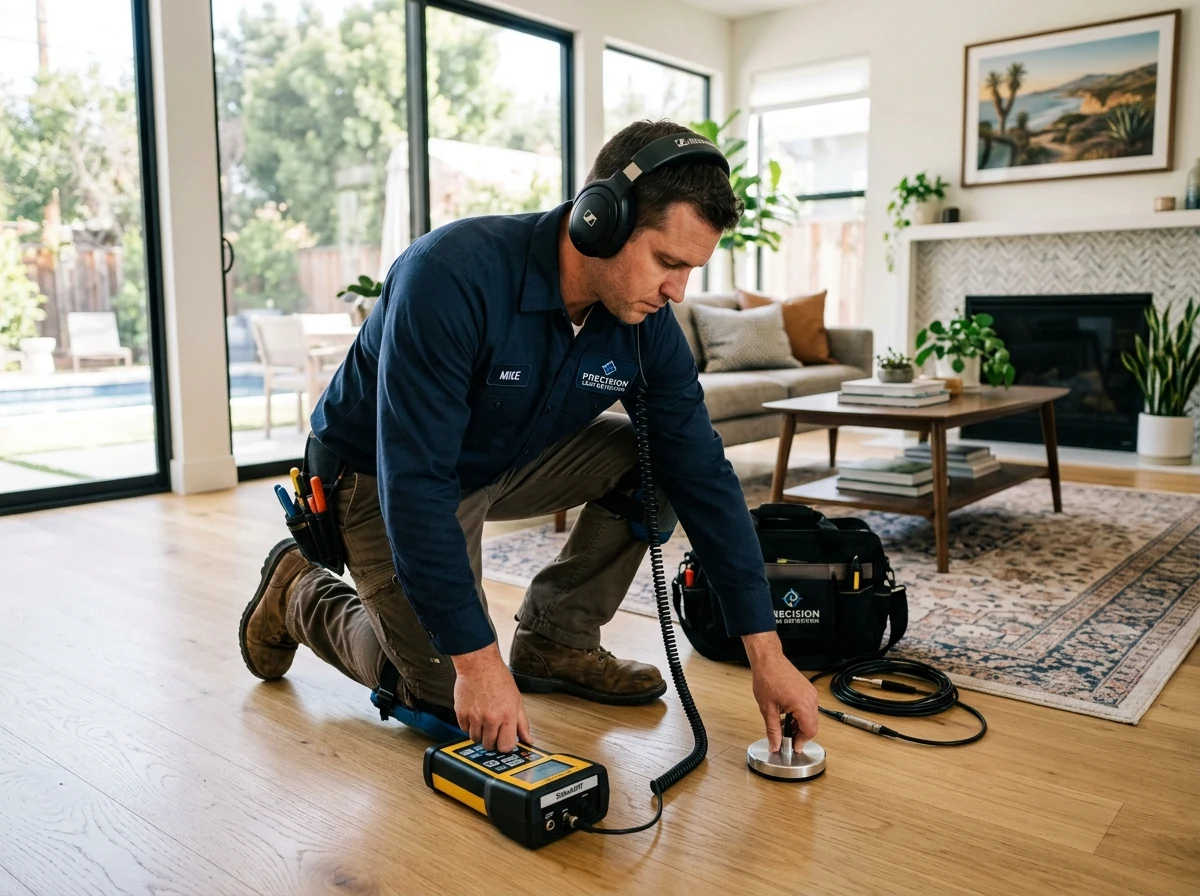
Coverage Status: Usually Covered (When resulting damage exists). If specialized electronic acoustic listening or thermal imaging is required to locate the leak source damaging your home, insurers generally categorize this diagnostic cost as part of the covered investigation.
"Tear-Out" & Access to the Foundation
Coverage Status: Heavily Covered under HO-3 Policies. Breaking through reinforced concrete to reach the ruptured pipe, removing damaged flooring, and subsequently repouring the concrete and reinstalling flooring materials represents 70% to 85% of total project costs—and is explicitly covered under standard tear-out provisions.
The Actual Plumbing Pipe Repair
Coverage Status: Almost Always EXCLUDED. The physical copper pipe fitting, coupling, or soldering work (typically $250 to $600 of direct plumbing labor and materials) is considered maintenance and must be paid out-of-pocket by the property owner.
The "Tear-Out" Clause: Why Access is Usually Covered
In the standard ISO HO-3 insurance policy form utilized across California, the dwelling coverage section contains critical language regarding plumbing access:
"If a loss to covered property is caused by water or steam escaping from a plumbing system, we will pay the cost of tearing out and replacing any part of the building necessary to access and repair the system."
This single clause is the homeowner's greatest financial safeguard. While the insurance company will decline to pay for the $15 piece of replacement copper pipe, they are legally obligated to pay for jackhammering through the slab, excavating the trench, backfilling, pouring structural concrete, and restoring your damaged hardwood, carpet, or tile floors back to their pre-loss state.
Sudden & Accidental Discharge vs. Continuous Seepage
The single greatest obstacle California homeowners face when filing a slab leak claim is the "Continuous or Repeated Seepage Exclusion" (frequently cited as the 14-day rule). Insurance contracts cover water damage that is sudden and accidental, but exclude moisture damage that occurs continuously over weeks, months, or years.
If mold has visibly spread up drywall or baseboards have rotted into dry powder, an aggressive claims adjuster may argue that the leak existed for months and attempt to deny the claim. This is why immediate, documented electronic diagnostics are essential: an acoustic diagnostic report proves the precise moment pressurized water loss was discovered and isolated, protecting your rights under California insurance regulations.
Need a Formal Diagnostic Report for Your Adjuster?
Our affiliated diagnostic technicians provide detailed written inspection reports complete with acoustic frequency readings, thermal imaging thermal maps, and precise location marking that insurance adjusters require for claim approval. Call our intake team at (562) 245-5818.
Insurance Coverage: Direct Spot Repair vs. Overhead Reroute
When a slab leak occurs in an aging copper pipe under a foundation, modern plumbing codes and common sense advise against jackhammering the floor for a localized "spot repair"—because repairing one pinhole creates thermal stress that frequently triggers a second leak nearby within months. The gold standard solution is an overhead PEX repipe / reroute through the attic or ceiling.
How do insurance companies handle rerouting?
- The "Cost of Tear-Out" Benchmark: Under California insurance law, insurers typically pay an allowance equal to the cost of tearing out and replacing the concrete floor. If tearing out the floor to perform a spot repair would cost $4,500 in concrete and tile restoration, the insurer will frequently apply that $4,500 allowance toward the overhead reroute, which is cleaner, less disruptive, and more permanent.
Why You Must Have an Independent Diagnostic Report
Never call an insurance claims adjuster to your home before having an independent leak detection specialist perform non-invasive electronic diagnostics. If an adjuster arrives when you merely have a vague suspicion and no verified evidence, they may classify the issue as "pre-existing moisture" or "groundwater intrusion" (which standard insurance policies strictly exclude).
Having a documented report confirming:
- Continuous flow on the municipal pressurized domestic potable line;
- Acoustic verification of pressurized discharge beneath the slab; and
- Infrared thermal documentation of sub-slab hot water pooling;
provides the indisputable forensic proof required for immediate claim approval.
Step-by-Step: How to File a Foundation Leak Claim in LA County
Mitigate Immediate Water Loss
Turn off your main shutoff valve or isolate the water heater. California law requires policyholders to take reasonable steps to prevent further consequential damage once a leak is discovered.
Obtain Professional Non-Invasive Diagnostics
Call Whittier Leak Detection Pros at (562) 245-5818. Have our specialists pinpoint the leak electronically and provide a detailed written diagnostic finding.
Call Your Insurance Carrier's Claims Hotline
Report the claim as "sudden and accidental water discharge from a pressurized foundation plumbing line." Provide the diagnostic report and request an adjuster inspection for tear-out and remediation.
Document Everything with Photos & Video
Photograph damp baseboards, warped flooring, and the technician's thermal camera display before any demolition or pipe repair begins.
When Should You File a Claim vs. Paying Out-of-Pocket?
With California homeowners facing skyrocketing insurance premiums and policy non-renewals, filing small claims is not always financially prudent. Consider this rule of thumb:
- Do NOT File a Claim: If total repairs (diagnostic fee + pipe reroute + drywall patching) total under $3,000 to $4,000, and your deductible is $1,500 or $2,500. The minor payout is not worth the risk of premium surcharges or loss of claims-free discounts.
- DO File a Claim: If the slab leak caused substantial secondary damage—such as ruined hardwood flooring, extensive sub-slab jackhammering across custom tile, or kitchen cabinet saturation—where total restoration costs exceed $8,000 to $25,000.
Frequently Asked Questions
Will insurance pay to match my continuous hardwood or tile flooring?
In California, under the Fair Claims Settlement Practices Regulations, insurers are generally required to provide a reasonably uniform appearance. If your damaged hardwood or tile runs continuously through hallways and living areas without transition strips, the carrier must often pay to replace or refinish the entire continuous area rather than leaving an obvious mismatched patch.
Does homeowners insurance cover water bills from a slab leak?
Standard homeowners insurance policies do NOT reimburse elevated utility water bills. However, the City of Whittier Water Division and Suburban Water Systems offer municipal leak credit adjustment programs. Read our guide on requesting utility bill relief in Whittier.
Can my insurer cancel my policy for filing a slab leak claim in California?
Under California Insurance Code, carriers cannot arbitrarily cancel an active policy mid-term simply for filing a valid claim. However, having a water loss claim on your CLUE (Comprehensive Loss Underwriting Exchange) report may impact renewal rates or make shopping for new coverage more expensive upon renewal.